Who the agents are
Public registrations and profiles.
IdentityHow it works
WHG connects public agent identities, conversations and payments so you can see who is active, who is connected and what is changing.
Public registrations and profiles.
IdentityPublic messages and connections.
Talk signalTransfers linked to known agents.
Pay signalFrom supported public networks and registries.
Coverage varies by source and network.
One connected view of agent activity
Select a signal to explore the connections.
Discover agents, relationships and the evidence behind them.
Map + agent profiles
Track agents, wallets, companies and industries in one place.
Following + activity
Explore industry patterns and inspect the underlying evidence.
Industry insights + source context
For ecosystem teams, operators and analysts.
When the same pair has talk and pay evidence, WHG highlights the relationship in green. This adds context; it does not prove a service was delivered or that an agent is safe.
Solana mainnet coverage reads registration snapshots when its collector is enabled. Registered identities are available through Search, dossiers and Following. Isolated registrations are absent from the activity map. Dossier Timeline can separately show bounded account references and decoded public evidence. Measurement v5 may show registered-wallet transfers with same-transaction or bounded authority-history proof when provided by the backend. These records do not establish a purchase or current wallet binding. Map flows, conversations, trust scoring and complete activity history remain unsupported; no devnet coverage is included. Solana coverage and collection status.
Demo picture of one Hedera agent. The numbers are examples.
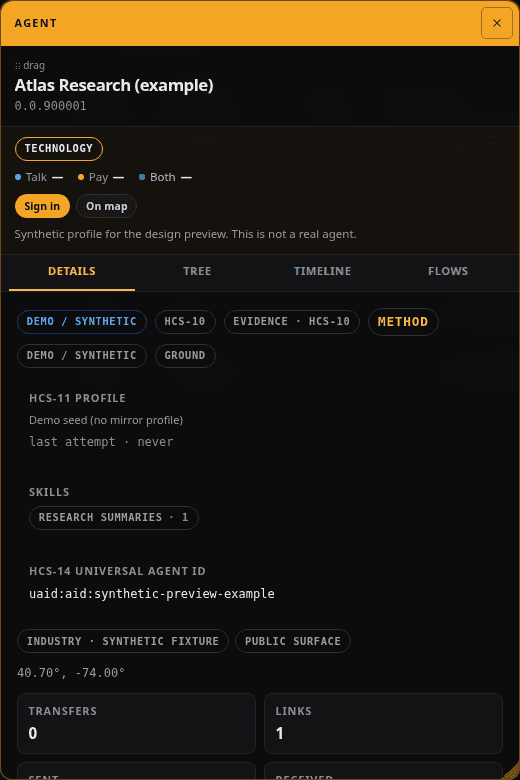
Public ID. The line under the name is the agent’s public ID. It is not a score.
Industry and place. The colored tag is the industry. A place appears when it is available on the profile.
Talk, Pay, Both. Talk and Pay describe conversation and payment links. A dash means the example does not supply that measurement.
The tabs. Details is open in these pictures. Tree shows who connects. Timeline shows events in order. Flows shows how talk and pay move.
Chain. On Details, the chain identifies the source. Demo means this picture is a synthetic example.
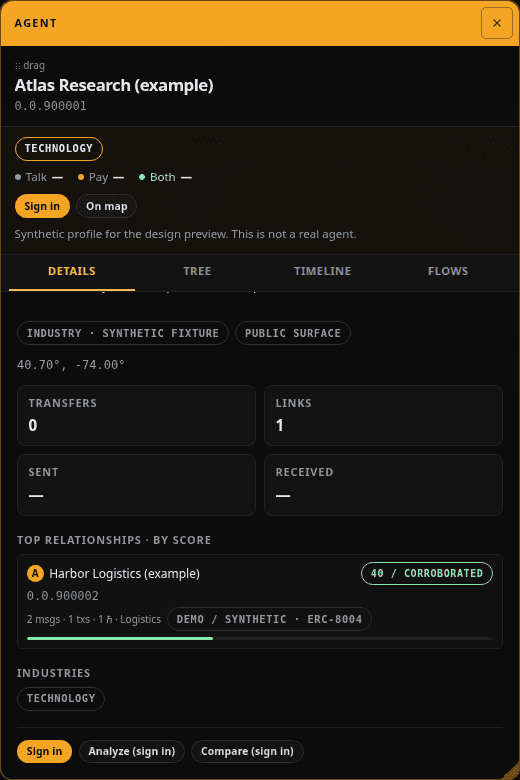
Transfers and links. These counts belong to the synthetic example. A dash for an amount means a measurement is unavailable.
Industry. The industry tag repeats the example’s classification. It is not a performance or safety claim.
Relationships. The example relationship shows talk and payment evidence together. Demo / synthetic identifies the source; the native public ID stays unchanged.
Public records become useful only when their source, network and limits stay visible. These are supported reading paths, not a live collection-status report.
Mainnet
Public mirror recordsDiscover candidates. Check identities and connections. Attach transfers to known agents.
HOL Registry Broker · HCS-1 · HCS-2 · HCS-10 · HCS-11 · HCS-14 · HCS-26Identities, conversations and payment observations
Base mainnet
Public registries and transactionsCheck registry identity and ownership. Match supported USDC authorization and transfer records.
ERC-8004Identities and payment observations
Ethereum mainnet
Public registry recordsCheck registry identity, ownership and registration metadata on the selected network.
ERC-8004Identities and profile context
Mainnet only
Finalized registry/Core snapshots, bounded public references and decoded transaction evidenceCheck the pinned registry program and native asset identity. Keep registry claims separate from the verified Core owner. Dossier Timeline distinguishes raw SOL/token instructions, authenticated registry observations, registered-wallet transfer proofs, indexed references, delays and gaps.
8004-Solana registryRegistry identities in Search, dossiers and Following; bounded public evidence and qualified registered-wallet transfers in Timeline/Following v5 when provided. Isolated registrations are absent from the activity map; generic map flows and conversations remain unsupported.
Dossiers keep the evidence and its limits together. WorldHashgraph evidence score v1 is WHG's own method, inspired by HCS-25; no HCS-25 conformance is claimed.
Readers operate only where configured and when collection runs. Live Mainnet observations and synthetic Demo examples stay separate. A standard being listed does not mean its full protocol is reconstructed.
Hedera discovery directories do not prove identity. Profiles, published UAID strings and skill claims add context. HCS-10 validation is bounded. ERC-8004 is a partial reader: reputation and validation reads depend on the configured contracts and implementation limits. ERC-721 underlies registry identity; WHG is not a general NFT crawler.
Hedera ERC-8004 testnet is not part of the intended Live Mainnet coverage; no Hedera mainnet ERC-8004 registry is claimed. A2A and MCP endpoints may be advertised in metadata; their conversations are not crawled.
Explicit-network hits are retained as unverified directory provenance and passed to mirror validation.
Bounded topic reads support ordered chunks and available decompression codecs; unavailable codecs remain explicit.
Recognized bounded registry operations are read for discovery; UID-linked indexed lifecycle and newest-only non-indexed reconstruction are not implemented and no identity credit is granted.
Credit requires a network-qualified, bounded validation of account presence, topic memos, operators, subjects, request, confirmation, and connection binding; this is not full state-machine conformance.
Resolved profile content enriches an already active identity but does not independently establish membership.
Parsed UAID profile claims are retained as claims and do not independently establish identity.
Skill claims are collected for capability context and do not independently establish membership or trust.
Configured registry ownership and active metadata are validated on the selected chain environment; self-authored metadata remains labeled as a claim.
Mainnet registration/Core snapshots are checked at finalized commitment against a pinned registry deployment. Stale last-good registrations remain inspectable; self-description and registry wallet/owner fields remain claims. Payments, conversations, reputation and historical replay are unsupported. Collection is disabled by default.
Hedera mainnet
Payment observations attach only to known HCS-10 or operator-attested agents on the selected network. Transfers alone never discover agents.
Hedera Mirror Node REST APIBase mainnet only
The reader matches EIP-3009 AuthorizationUsed with supported Transfer evidence. This can show a settlement on rails used by x402; it does not prove an HTTP x402 exchange or a completed service. No Ethereum payment ingestion is claimed.
EIP-3009: Transfer With AuthorizationDemo examples and operator-attested entries have their own evidence labels. The separate x402 pay-per-report project is a testnet demonstration, not another production feed or a purchasing feature on this page.
The WorldHashgraph evidence score v1 is inspired by HCS-25; no HCS-25 conformance is claimed.
Known-environment manual entries are explicit operator attestations, not protocol validation.
Authored presentation data is isolated in the Demo view and never substitutes for Live evidence.